Bible Reading Plan: John in January (John 2)

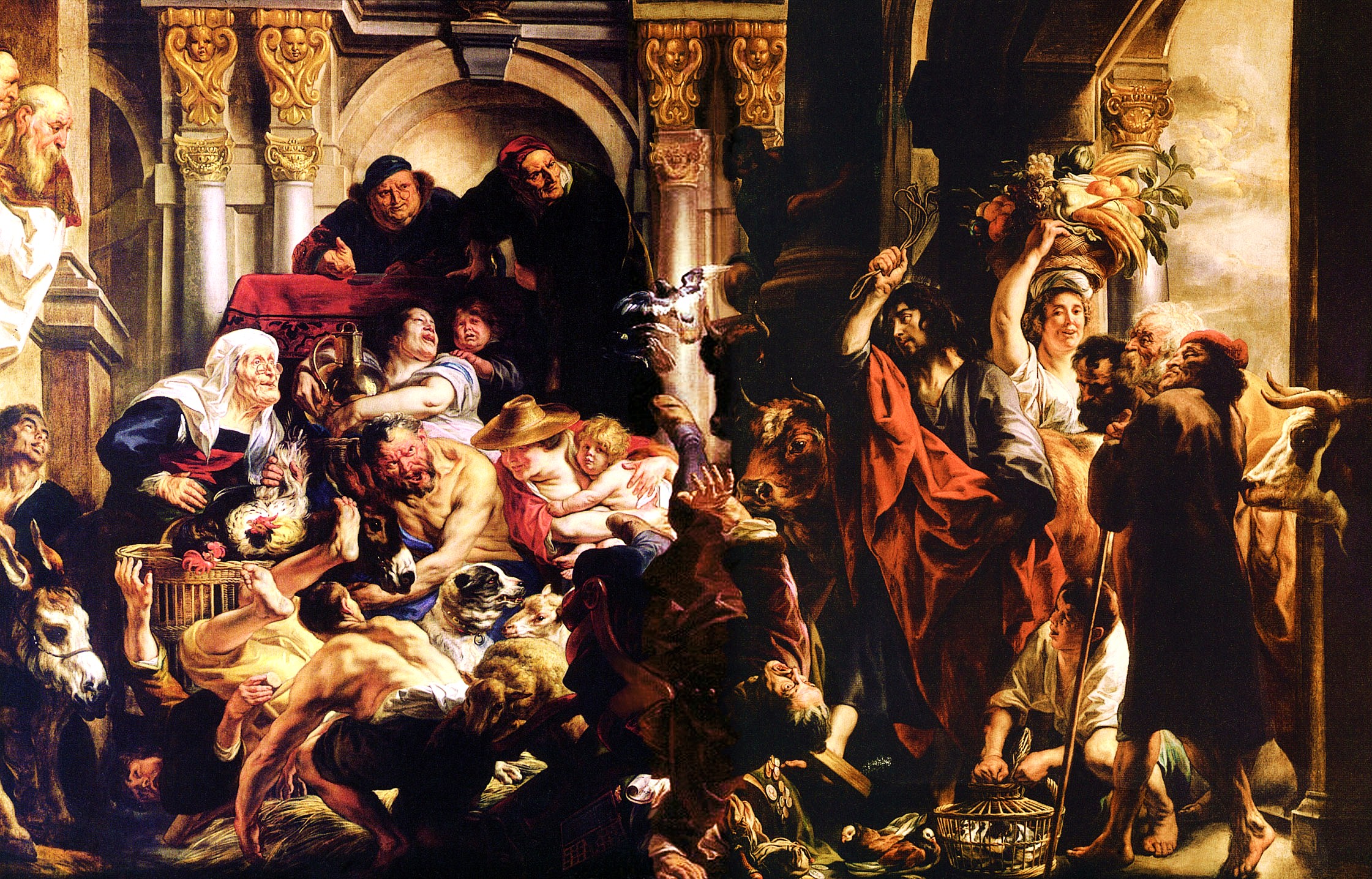
"Jesus Drives the Merchants From the Temple." Jacob Jordaens, 1650. Louvre, Paris.

“Jesus Drives the Merchants From the Temple.” Jacob Jordaens, 1650. Louvre, Paris.

I am a fan of reading the chapter titles in books before reading the book itself. Usually, I read the back cover first and then turn to the Table of Contents and read the chapter titles. There is something about knowing what’s coming next that gets me engaged. Some authors don’t give much away and just number their chapters while others write such good titles for their chapters that it makes you curious of what story the book contains. But, sometimes looking at the chapter titles can be a bad thing. Especially when it comes to the Bible, since all the subheadings that the chapters in the Bibles have were not inspired by the Holy Spirit. In reality, the chapter numbers and verse numbers were added years later to make it easy to read. Sometimes those things make it much harder to read Scripture. Sometimes.

Last year, my wife and I purchased Readers’ Bibles for ourselves. Crossway put out these Bibles that took out all of the chapter numbers, verse numbers and subheading titles. They make good reading Bibles. Check them out here. End commercial. What these Bibles help us in is to not be guided by subheading titles, but be guided by Scripture itself. John 2 is a great example of this misguided way of reading Scripture based on the subheadings.

As I read John 2, I focused on the subheading titles that John 2 has. “The Wedding at Cana” and “Jesus Cleanses the Temple.” Quickly, I made up my mind about John 2. “Oh, here is where Jesus turns water into wine and where he goes crazy on the people selling stuff at the Temple.” But, in reality the text has much more to say about Christ and the purpose He came to earth. Sure, one can’t dismiss those details of Jesus’ life, but here is where the Holy Spirit gives believers illumination so they can read and understand. Side note: Every time you read Scripture, you should be asking the Spirit to show you what He meant through it. The reading of Scripture is not for us to just know about God, rather it is to give us God’s purpose through them.

Jesus’ Hour
So, before you get sidetracked with the subheading titles, read the text as it is laid out. When you do this, you make Bible Study Methods professors proud. “Observation” is what the method is called. When you read the Scriptures carefully, you start to notice several words, phrases, and ideas that jump out. In reading John 2, what jumps out at you? What does John highlight here? There is an idea that John threads through the two stories found in John 2 and this idea travels throughout his gospel. John highlights the phrase, “my hour.” Jesus says, “my hour” many times throughout his life and John captures that many times in his narrative.

When Jesus’ mother pressed him to do something about the lack of wine at the wedding in Cana, He addressed her with authority and said that His “hour” had not yet come. Jesus said,

“Woman, what does this have to do with me? My hour has not yet come.” (John 2:4)

His “hour had not yet come.” The other day, my wife and I were having a conversation about Jesus turning water into wine and His statement about His “hour” having not yet come. What does Jesus mean when he says “My hour has not yet come?” His “hour” was that glorious period of time of His crucifixion where He would pay the debt of sin with His perfect life. At the wedding in Cana, His “hour” had not yet come, though. In other words, His time to be crucified was not then. Jesus was strategic in revealing Himself to people and He knew that He could not do so very openly at that particular time. Jesus had not come to overthrow the political government of Rome. Jesus had come for a higher purpose. He knew what was in man’s heart and He knew that what they thought the Messiah would be was not at all what His “hour” would accomplish. So, in Scripture we see Him saying this phrase and withdrawing. Here and there, He gives us signs, but does not fully reveal Himself to all people. At this time in Cana, His “hour” had not yet come. The time of His crucifixion had not yet arrived.

The Temple
Another thing that pops up when you read chapter 2 of John is the issue of destroying the temple and raising it up in three days. This happens in Jerusalem after the wedding at Cana. Jesus gets angry at the moneychangers that are “selling oxen and sheep and pigeons” for sacrificial purposes. Jesus’ zeal flares up because they’ve made His Father’s house a place of bargaining and trade. “That is a great picture of Jesus,” we say. We love that! But, in doing this, we miss out on the point of this story… on what He says afterward. It is what Jesus says next that we should pay close attention to since it is what connects what He is doing in Jerusalem to what He did in Cana.

Jesus says,

“So the Jews said to him, “What sign do you show us for doing these things?” Jesus answered them, “Destroy this temple, and in three days I will raise it up.” The Jews then said, “It has taken forty-six years to build this temple, and will you raise it up in three days?” But he was speaking about the temple of his body.” (John 2:18-21) 

What pops up is the analogy that Jesus makes to the physical building of a temple where people would go and worship to his own body as a temple. The Jews around him didn’t get it. He was talking about his own body. There would be a time when Jesus’ body, the true temple, would be destroyed at the cross for Him to rise up three days later.

The Connection
Do you see the connection between these stories? Do you see the inferences that Jesus started with in his first 3 days of His earthly ministry? More than the miracle of turning water into wine at Cana and more than driving out the moneychangers from the Temple in Jerusalem, Jesus’ hour to die had not come. The temple of his body would be destroyed and raised in three days. The connection that we have in these two stories is the fact that Jesus was talking about the purpose that He had in coming to this earth. The glimpses of His death and resurrection become clear when you actually pay Jesus the attention He deserves. His “hour” and the “temple of His body” become so clear that it is difficult to ignore. You and I must wrestle with that. With the fact that Jesus came to dies for our sins. Jesus makes it clear in His first week of ministry that the purpose of His coming was to die for the sins of His people. May we see Jesus’ ministry in this light every time we read Scripture that testifies about Him.

For all “John in January” posts, click below:
Click Here for John 1, Part 1
Click Here for John 1, Part 2
Bible Reading Plan: John in January (John 1, part 2)

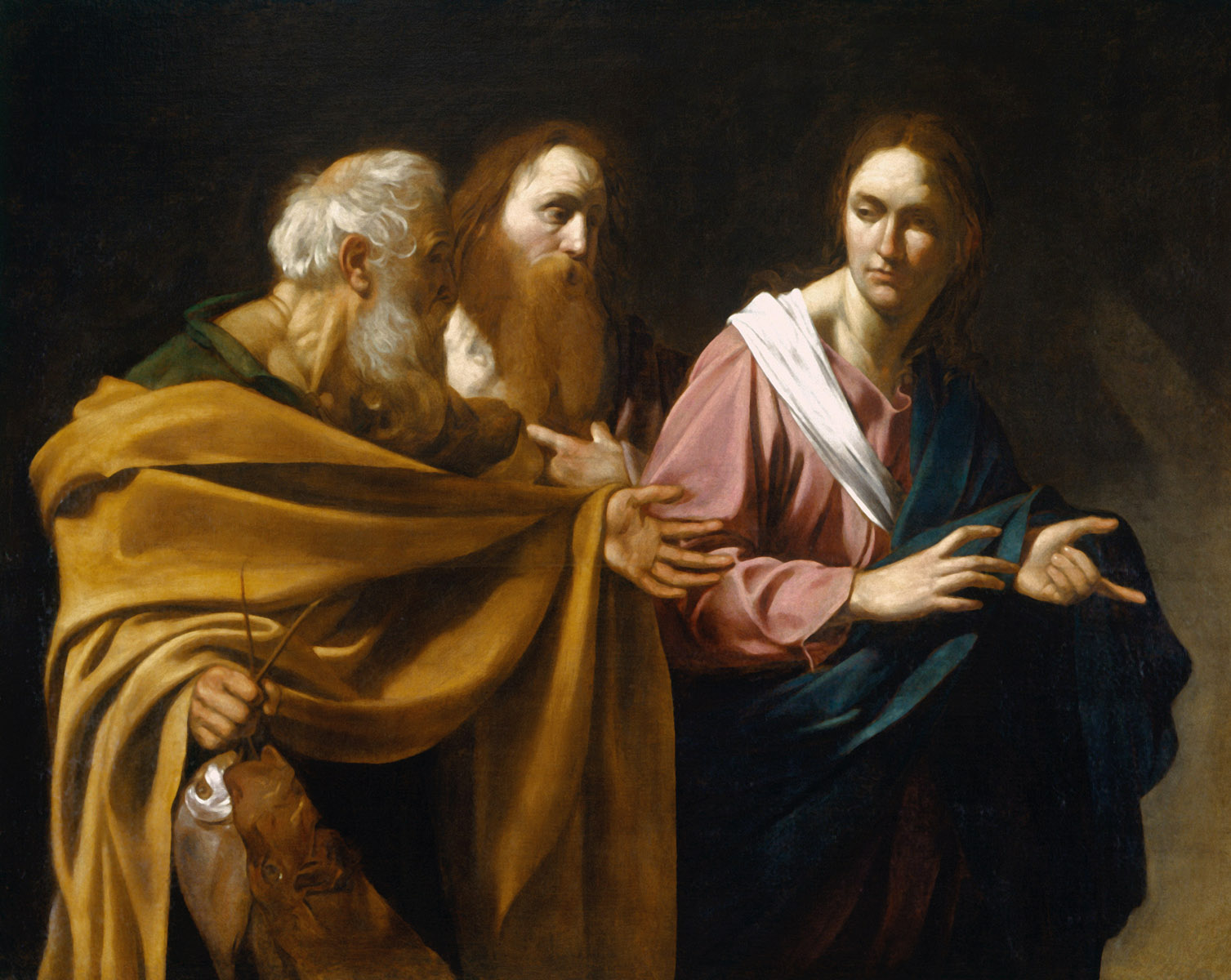
"The Calling of Peter and Andrew." Caravaggio, 1602.

“The Calling of Peter and Andrew.” Caravaggio, 1602.

Click Here for John 1, Part 1

There is something to be said about repetition. Yesterday, I was with six church planters and one of our facilitators talking about sermons. We focused on the art of repetition in sermons, and although John in his book is not writing an official sermon, when one reads John 1, the reader is struck by the repetition that John does when it comes to the phrase, “Come and see.”

“Come and See.” 
After John states the fact that Jesus is God (see this post), the Savior starts to call men to take part in His mission. But, the interesting thing is that He starts by showing them how He lives. Many have made much of the phrase “come and see,” not really looking at the context of when it was said. To give them credit, people probably are referring to the second “come and see” phrase that Philip tells Nathanael. But, there is a “come and see” before that one and it is spoken by Jesus. This first “come and see” phrase is an invitation from Jesus to two of John the Baptist’s disciples. The disciples are Andrew and another one who is not named, but most scholars believe it was John. Their curiosity about Jesus leads to an invitation from Jesus to see where He lives. Who would not be curious about a man whom John the Baptist had referred to as the “Lamb of God?” (John 1:36) In an exchange of conversation these two curious disciples of John asked Jesus where he was staying. Jesus tells them plainly, “Come and see.” Curiosity and dialogue will get us to answers but it is obedience to those answers that gets us to a changed life.

Curiosity and dialogue will get us to answers but it is obedience to those answers that gets us to a changed life.

That obedience came the moment that Andrew and John took their first step to follow Jesus to where He was staying. That was the moment that they started to be on mission with God. They didn’t know much of who Jesus was. Yes, they knew about the coming arrival of the Messiah, but their theology had not been worked out completely. Yes, these guys knew the Scriptures, recalled a lot of it during their lives, but they were not there yet. Until, they grabbed their bags and followed after Jesus. Even then they had a lot to learn, but this obedience, this going after Jesus, was a pivotal moment in their lives, for sure.

This is a spiritual moment without the spiritual overtones that modern Christians work out of nowadays. This act of going with Jesus and seeing where He was staying was so mundane and so sacred at the same time. Much of the life we live is a routine, but in that routine as boring or as uneventful or as uninteresting as it may be, we must recognize that God is at work and calling us to go where He stays.

Much of the life we live is a routine, but in that routine as boring or as uneventful or as uninteresting as it may be, we must recognize that God is at work and calling us to go where He stays.

That day, Andrew goes to his brother Peter and brings him to Jesus. After they hang out all night, Jesus gets up the next day and goes to Galilee. Jesus is on a mission. Jesus pitches the mission to Philip with the words, “Follow me” and Philip is on board. Philip, quickly finds Nathanael; the naive, young, idealist Nathanael and tells him to “come and see” Jesus. This starts with Philip referring to Moses, the Law, and the prophets and follows with Nathanael dismissing it for a short moment. But, when Philip makes the invitation to “come and see” Jesus, Nathanael goes with Him. It is during the conversation with Jesus that Nathanael understands that Jesus is God. When Jesus sees Nathanael’s amazement at this fact, Jesus tells him, “Truly, truly, I say to you, you will see heaven opened, and the angels of God ascending and descending on the Son of Man.” (John 1:51) Flashbacks of Jacob, the patriarch of the Old Testament, and his ladder go through Nathanael’s mind. (Genesis 28) This response of faith, as dismissive as it was in the beginning, to a simple “come and see,” changed Nathanael’s life from that point on.

Do you see the two instances of “come and see” in this passage? When reflecting on them, we come to the realization that the mundane is as important and interesting as the sacred. The first “come and see” was to follow Jesus to where he was staying. Yes, maybe there was some thing, some further explanation about the Christ, something more about this “Lamb of God” that we don’t know about and that John does not give us. But, it is safe to say that what these two disciples wanted to find out right then from Jesus was where He was staying. The second “come and see” was to find out more about a man “whom Moses in the Law and also the prophets wrote.” (John 1:45)

Once you take the first steps to follow Jesus, whether it is a simple curiosity that was sparked when someone told you that He was the Lamb of God or whether it was because you were actively awaiting the man whom Moses and the prophets wrote about, your life changes.

Once you take the first steps to follow Jesus, whether it is a simple curiosity that was sparked when someone told you that He was the Lamb of God or whether it was because you were actively awaiting the man whom Moses and the prophets wrote about, your life changes. Your life changes when you meet the man who is God. For you who follow Jesus, there will be an opened-heaven, ascending-and-descending-angels, Son-of-man moment.

Yes, Jesus is God. And He is calling you to come and see how good He is. He is calling you to be on His team. He calls you to be on His mission. Whether you just want to know where He stays or whether you refer to Him as the fulfillment of what Moses and the prophets talked about, just come and see. Come and see. If you come and see, then this God-man will turn your world upside down.

Whether you just want to know where He stays or whether you refer to Him as the fulfillment of what Moses and the prophets talked about, just come and see.

Bible Reading Plan: John in January (John 1, part 1)

Read JohnThis year, I want to focus on reading a whole book of the Bible every month. Maybe I’ll end up reading the whole Bible this year, on one of those times where I end up sitting down and not getting up until I finish Deuteronomy or something like that. It is possible, or maybe I’ll get in on the Bible reading plan that my wife is going through this year. But, for January, I thought I’d tackle the Book of John on the blog. Tackle may not be the right word. Soak is probably better.

So, this week I’ll be reading John 1-5 every day with the hope of reading the next 5 chapters next week and so one for the rest of January (this is a method I learned a few months ago from Jeremiah Morris, the Director of Evangelism and Mobilization at First Presbyterian Church of Houston). It takes me about 30 minutes to read 5 chapters without rushing it. I just timed myself. I, occasionally, stop at a verse that jumps out and write a note on the side it. It helps having a journaling Bible. It also helps if you read the English Standard Version of the Bible, but that’s another story. 🙂 I may not write a blog about every chapter, because of lack of time, but I wish to write a few posts about what I am reading. I hope you are blessed and encouraged by it. Today, we look at some of John 1.

John comes right out of the gate with a sweeping statement of who Christ is. The imagery of life, light, darkness, flesh, grace, truth is thick and grand. When you read it, you wonder who this John, this author of this book really is. But, then you realize that it was the Holy Spirit who inspired John to write these words and John comes out saying that Jesus is God. In the first few verses, he writes that Jesus was in the beginning with God and that He is God and nothing that is made was made without Christ having a hand in it (John 1:1-3). This is one of my favorite theological topics for me.

There are wonderful shifts that takes place in verse 14 and 19. Verse 14 describes that this Jesus who is God became a human. That is huge! The God from eternity shows up on earth as a human being. Not rejecting his deity, He takes the form of a servant and becomes a human. See Philippians 2:5-8 for a little bit more on this. But, John chapter 1 verse 14 lets us know that Christ became human, was full of grace and truth and that He gave Himself to people who were to receive Him. Verse 18 is clear that although no one has seen God, God has shown Himself and revealed Himself in Jesus Christ. Jesus has made God known by Him standing there in a physical body and fully expressing His deity at the same time. This causes one to worship.

Verse 19, though, brings Jesus to the time where He is a grown man and John the Baptist, his cousin starts to cry out in the wilderness telling everyone that Christ is coming. Remember that John, the author of this book and John the Baptist are two different people. John was a popular name back then, I guess. So, Jesus shows up and John starts telling people that Jesus is the lamb of God, the one that takes away the sins of the world. John, Jesus’ cousin, says that he didn’t know Jesus, as God obviously, until He saw the Spirit descend from above and fall on Jesus. He didn’t know He was God until it was confirmed to him by the Holy Spirit. In reality, we don’t know who Jesus really is until the Spirit reveals it to us. As we see Him working in our lives, the Spirit will show us that Christ is God. Without the Spirit’s help we cannot say that Christ is Lord. We need the Spirit to guide us and lead us to this truth.

Jesus, then, starts to call men to fulfill His mission. I’ll pick this up in the next blog post and write about this later.

For now, the message is for you to believe that Jesus is God and the Holy Spirit is the one who reveals this to you. I encourage you to continue reading the account of John so you can see that Jesus is God. After all, John wrote his book “so that you may believe that Jesus is the Christ, the Son of God, and that by believing you may have life in his name.” (John 20:31) May you come to believe this truth: Jesus is God and only He can take away your sins.